
What Is the Difference Between Convection Bake vs Bake? (Simple Explanation)
Imagine opening your oven door to find perfectly browned cookies or a roast cooked evenly on all sides. You might wonder whether convection bake or regular bake is behind that result. Understanding the difference between convection bake vs bake can change how you approach cooking and improve your dishes.
Let’s explore what sets convection bake apart and when you might choose one over the other. This knowledge will help you get the best results from your oven every time. Whether you’re baking bread, roasting vegetables, or cooking a turkey, knowing these methods makes a big difference.
What Is Convection Bake?

How does convection bake differ from traditional baking? With convection bake, your oven uses a fan and additional heating elements to circulate hot air evenly around your food. This air circulation guarantees even heat distribution, so your baked goods brown uniformly and cook faster.
Because of this efficient heating, you’ll want to lower your oven settings by about 25°F compared to traditional baking to avoid over-browning. The fan also helps remove excess moisture, giving you crispier textures, perfect for roasting meats or baking multiple racks at once.
How Do Convection Ovens Work?

When you use a convection oven, a fan and exhaust system actively circulate hot air throughout the oven cavity. This hot air circulation guarantees even cooking by improving temperature distribution and reducing hot spots.
Many convection ovens feature a heating element near the fan, known as true convection, that boosts airflow and speeds up cooking times. Here’s how the convection oven works:
True convection ovens use a fan and heating element to enhance airflow and accelerate cooking times.
- The fan circulates hot air evenly, promoting uniform baking on all racks.
- The heating element maintains consistent temperature distribution.
- Airflow removes moisture, creating crispy textures and even browning.
- Reduced hot spots lead to more efficient cooking and reliable results.
What Is Regular Bake?
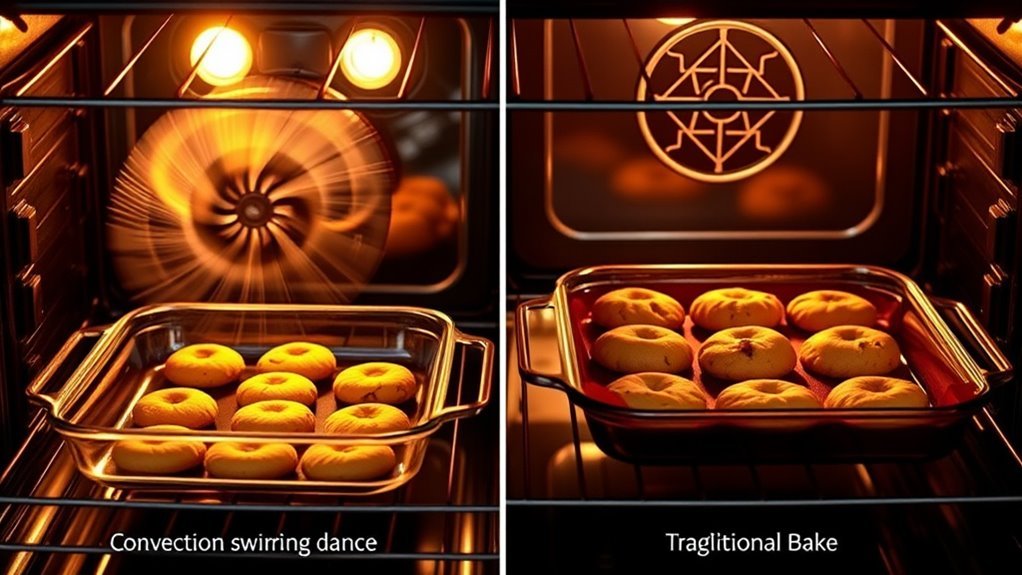
What exactly happens during regular bake? With regular bake, your oven uses only the top and bottom heating elements without a fan, providing consistent heat. The oven temperature usually ranges between 200°F and 375°F, offering slow, even cooking.
This traditional baking method is perfect for delicate baked goods like cakes and custards, as it helps with moisture retention. Since there’s no hot air circulation, baking time is generally longer than convection baking.
| Feature | Description | Benefit |
|---|---|---|
| Top and Bottom Heating | No fan, uses heating elements | Consistent heat |
| Oven Temperature | 200°F to 375°F | Gentle, even cooking |
| Hot Air Circulation | Minimal, no fan | Moisture retention for delicate baked goods |
When to Use Convection Bake vs. Regular Bake
Although both convection bake and regular bake serve important roles in the kitchen, choosing the right method depends on the results you want to achieve. You’ll want to consider your baked goods and desired textures when selecting oven settings. Here’s when to use each:
- Use convection bake for even cooking and crispy textures, especially with roasted vegetables, meats, or multi-rack baking, thanks to enhanced air circulation and heat distribution.
- Opt for regular bake for delicate baked goods like cakes or custards that need gentle, uniform heat without over-browning.
- Choose convection bake to reduce cooking time by adjusting the temperature about 25°F lower than regular bake.
- Stick with regular bake when moisture retention is vital, such as for soft-crust bread or recipes requiring traditional baking techniques.
Knowing when to adjust temperature or cooking time guarantees perfect results every time.
Key Differences Between Convection Bake and Regular Bake
Since convection bake uses a fan and exhaust system to circulate hot air, it cooks food more evenly and quickly than regular bake, which relies solely on static top and bottom heating elements. This difference in heat circulation affects oven temperature, baking times, and the presence of hot spots.
| Feature | Convection Bake | Regular Bake |
|---|---|---|
| Heat Circulation | Fan and exhaust system | Static heating elements |
| Oven Temperature | Reduced by ~25°F | Standard setting |
| Cooking Speed | Faster | Slower |
| Even Cooking | Minimizes hot spots | May require tray rotation |
| Best Use | Crispy textures, multiple racks | Delicate, uniform baking |
Understanding these key differences helps you choose the right oven settings for perfect results.
Best Foods for Convection Bake and Regular Bake
Knowing how convection bake and regular bake differ helps you decide which method suits specific dishes. Convection bake excels in promoting even baking and crispy textures, while regular bake preserves moisture and suits delicate baked goods.
Here’s where each shines:
-
- Use convection bake for roasting meats and vegetables to achieve even browning and enhanced crust development.
- Choose regular bake for cakes, custards, and muffins needing gentle, uniform heat and moisture retention.
- Try convection bake for artisan breads and flaky pastries to boost crust development and texture.
- Opt for regular bake when preparing soufflés or delicate pastries that require careful baking techniques at consistent oven temperature.
Temperature and Time Adjustments for Each Baking Method
Because convection ovens circulate hot air more efficiently, you need to lower the temperature by about 25°F and reduce cooking time by roughly 25% to prevent over-browning and overcooking. When switching between convection bake and bake, adjusting your oven settings is essential for proper doneness.
Convection bake offers faster baking, so keep an eye on your food and check doneness earlier than usual. Here’s a quick guide for temperature and time adjustments:
| Baking Method | Temperature Adjustment | Cooking Time Adjustment |
|---|---|---|
| Bake | No change | Follow recipe |
| Convection Bake | Decrease by 25°F | Reduce by 25% |
| Doneness Check | As recipe suggests | Check earlier |
These adjustments imply your dishes cook perfectly every time.
Frequently Asked Questions
When to Use Convection Bake Vs Regular Bake?
Use convection bake for crispy, evenly browned foods like cookies or roasted veggies, and regular bake for delicate items like cakes or custards.
Don’t forget to lower the temperature by 25°F when using convection.
Is 350 Convection the Same as 350 Bake?
No, 350 convection isn’t the same as 350 bake. Because convection circulates hot air, you’ll want to lower the temperature slightly, usually by 25°F, to prevent overcooking and guarantee evenly cooked, crispy results.
Is Convection Bake 375 the Same as Bake 400?
No, convection bake at 375°F isn’t exactly the same as bake at 400°F, but it cooks faster and more evenly.
You’ll get similar browning and crispiness with lower temperature using convection.
Do I Need to Adjust Baking Time When Using Convection?
When you use convection, it’s like giving your oven wings. It bakes about 25% faster.
Conclusion
Choosing between convection bake and regular bake is like deciding whether to dance in a gentle breeze or a still room. Convection’s swirling air wraps your food in a crisp, golden hug, speeding up cooking and perfecting browning.
Regular bake, meanwhile, offers a steady, comforting warmth, ideal for delicate or slow-cooked dishes. By understanding their unique rhythms, you’ll master the oven’s symphony, creating meals that sing with flavor and texture every time.
In conclusion, knowing the difference between convection bake vs bake helps you choose the best method for your recipe. Whether you want faster cooking and crispiness or gentle, even heat, using the right setting ensures delicious results every time.