

How Long Should You Bake Polymer Clay: A Step-by-Step Beginner’s Guide
You might not realize that the exact baking time for polymer clay depends heavily on its thickness rather than just the overall size. Many people bake their polymer clay pieces too long or too short, risking cracks or undercooked sections. Understanding how to measure and calculate the correct bake time can save your project from damage.
Let’s explore the key steps you need to follow to get perfect results every time.
Understanding Polymer Clay Baking Basics
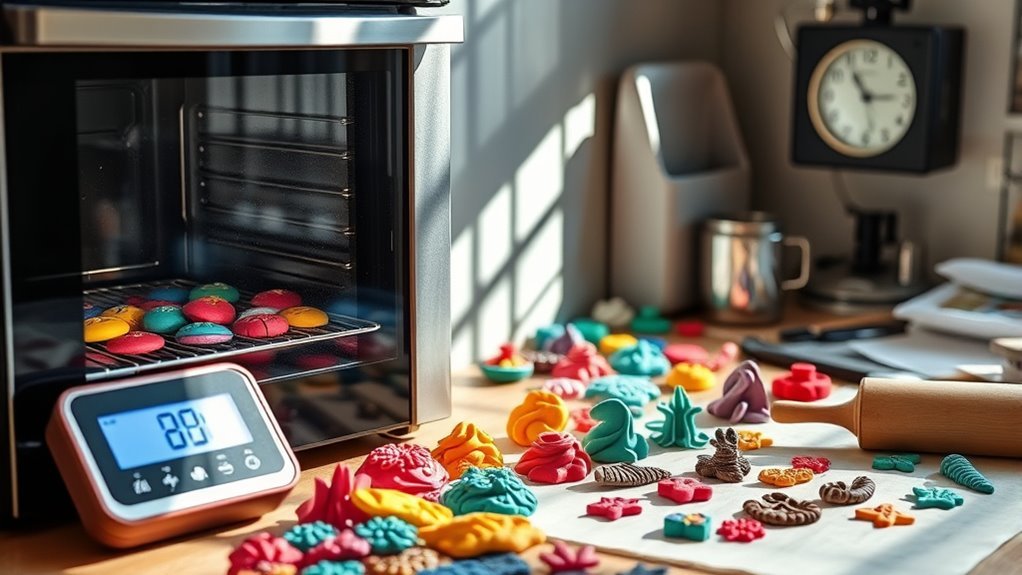
Although it might seem straightforward, baking polymer clay correctly is essential to attain the right hardness and durability. You need to control the oven temperature carefully, usually around 275°F (135°C), to ensure proper curing without burning or cracking.
Baking time depends largely on the thickness of your piece; a good rule is about 15 minutes per quarter inch. Thicker items require longer baking times to cure fully through the center.
Using a dedicated baking surface like a ceramic tile helps distribute heat evenly, so avoid metal trays that can cause hotspots.
Recommended Baking Temperatures for Different Brands

When you bake polymer clay, the temperature you choose can vary greatly depending on the brand you’re using. For example, Sculpey Premo recommends baking at 275°F (135°C) for best results.
While Kato and Fimo clays typically suggest temperatures ranging from 230°F to 266°F.
Always check the specific baking guidelines on your polymer clay brands’ packaging to guarantee you follow the correct curing process.
Using an oven thermometer is essential to confirm your oven’s actual temperature matches the recommended baking temperatures.
This helps avoid under- or over-baking, which can affect the clay’s durability and finish.
Determining Bake Time Based on Clay Thickness

Since bake time depends largely on your clay’s thickness, you should plan for about 15 minutes of baking per 1/4 inch (6 mm) of depth to guarantee proper curing.
To bake polymer clay effectively, measure your project’s clay thickness accurately and adjust baking times accordingly.
Thicker pieces often require longer baking times, sometimes 30 minutes or more per 1/2 inch, to ensure consistent curing throughout.
Always check the manufacturer’s recommended baking times for your specific clay brand, then tailor your bake time based on your clay thickness.
For larger or layered projects, consider baking in stages to promote even heat distribution and avoid undercooked centers.
How to Use an Oven Thermometer Effectively
To bake polymer clay successfully, you need to monitor your oven’s actual temperature using a reliable oven thermometer. Place it directly on the rack where you’ll bake to guarantee accurate oven monitoring.
Many ovens have poor oven dial accuracy, so calibrate oven settings by comparing the thermometer’s reading to the dial and adjust the bake temperature accordingly. Check the thermometer periodically to maintain consistent heat, which is vital for flawless baking.
| Step | Action |
|---|---|
| 1. Placement | Put oven thermometer on the baking rack |
| 2. Calibration | Compare reading to oven dial setting |
| 3. Monitoring | Check temperature regularly during bake |
Using a digital or probe thermometer helps you maintain precise bake temperature for polymer clay projects.
Tips for Preventing Cracks and Surface Issues
Although baking polymer clay can be straightforward, preventing cracks and surface issues requires careful preparation and control. To avoid clay surface cracks, start by properly conditioning your clay and removing excess water to prevent steam buildup during baking.
Next, maintain oven accuracy by using a reliable thermometer to keep a stable baking temperature. This helps prevent rapid temperature changes that cause cracking.
Finally, pay attention to thickness; thinner sections cure faster, so balance baking times accordingly. Cover your project with foil to protect the surface.
After baking, let your piece cool gradually. Avoid quick cooling or handling immediately to reduce stress cracks.
Following these steps helps ensure a smooth finish and strong, crack-free results every time.
- Condition clay and remove moisture
- Monitor and stabilize oven temperature
- Cool pieces slowly and handle carefully
Adjusting Baking Time for Complex or Thick Pieces
When working with thicker or more complex polymer clay pieces, you’ll need to increase the baking time to guarantee they cure thoroughly. For every additional 1/4 inch of thickness, add about 15 minutes to the baking time while maintaining the recommended oven temperature.
If your project involves layered baking, consider curing each layer individually to ensure even heat distribution and complete curing. Use a reliable oven thermometer to monitor the actual temperature, as fluctuations can cause under- or over-baking.
For complex shapes, tenting with foil helps prevent surface scorching and uneven heat exposure. Always test bake a small sample with similar thickness to fine-tune the baking time.
This careful adjustment will help you achieve a fully cured, durable polymer clay piece.
How to Fix Underbaked Polymer Clay Projects
If you find your polymer clay project feels soft or fragile after baking, you can fix it by re-baking at the correct temperature. Re-baking underbaked polymer clay helps improve clay strength and durability.
Before you start, clean the surface and apply liquid clay or glaze over cracks.
Then, follow these steps:
- Preheat your oven to the recommended curing temperature for your clay.
- Place the piece in the oven for additional baking, typically 15-30 minutes depending on thickness.
- After baking, let the clay cool completely before handling to prevent damage.
Best Practices for Cooling and Handling After Baking
Proper cooling and careful handling after baking are crucial to guarantee your polymer clay projects maintain their shape and durability. Always let your pieces cool fully on a heat-resistant surface before touching them. Handling them too soon risks warping or damage due to their fragility when hot.
To speed up cooling and improve strength, you can submerge baked items in cold water once they’ve rested briefly. Use tongs or gloves when moving hot or freshly baked clay to avoid fingerprints and accidental breakage.
Give your projects at least 30 minutes to be fully cooled and set before handling.
Finally, store cooled pieces in a dry, airtight container to protect their finish and prevent surface damage. Following these cooling and handling best practices ensures your creations stay beautiful and strong.
Frequently Asked Questions
How Long Should I Bake Polymer Clay?
You should bake polymer clay for 15 minutes per 1/4 inch of thickness at 275°F. Check your oven’s temperature, and for thicker pieces, increase time to avoid undercuring and guarantee durability.
Is It Possible to Bake Polymer Clay Too Long?
Yes, you can bake polymer clay too long. If you do, it may discolor, bubble, or become brittle.
How Long Do You Bake Fimo For?
You bake Fimo for about 30 minutes at 230°C (446°F) per 1/4 inch thickness. For thinner pieces, reduce time to 15-20 minutes per 1/8 inch.
Always check your oven’s temperature carefully.
Can You Bake Polymer Clay at 250 Degrees?
Baking polymer clay at 250°F is skating on thin ice. You can do it, but you’ll need to bake longer and watch temperatures closely. Otherwise, your piece might end up weak and less durable than you want.
Conclusion
Baking polymer clay is like a delicate dance between time and temperature—get it just right, and your creation will shine without cracks or flaws. By measuring thickness, using an oven thermometer, and letting your piece cool slowly, you’ll bring your art to life with a flawless finish.
So, trust your tools, watch the clock, and treat your clay with care. Your masterpiece is waiting to rise like a phoenix from the oven’s gentle heat. Remember, precise baking time and temperature are key to perfect polymer clay results.