What Size Storage Container Do I Need? A Complete Storage Size Guide
When deciding what size storage container you need, it’s important to start by evaluating the volume and type of items you plan to store. Whether you’re storing a few boxes or entire household furniture, understanding your storage needs is crucial. This helps you avoid paying for unused space or struggling to fit everything in.
Figuring out the right size isn’t always straightforward. However, considering a few key factors can make all the difference in choosing the perfect storage container. Taking the time to assess your belongings carefully will ensure you select a container that meets your requirements efficiently.
Understanding Container Sizes and Their Uses

How do you choose the right storage container size? First, consider the container sizes available and match them to your storage needs. Standard containers come in 10, 20, and 40 feet lengths, all with widths of 8 feet.
Heights vary between 8.5 feet and 9.5 feet for high cube options. The dimensions directly affect how much you can store: a 10-foot container offers about 80 square feet of floor space, perfect for small moves or limited storage needs.
For most household moves, a 16- or 20-foot container works well, providing roughly 160 square feet. If you have extensive storage or commercial inventory, the 40-foot container is your best bet.
Knowing these container sizes and their dimensions helps you pick the right fit for your specific storage volume.
Estimating Your Storage Space Requirements
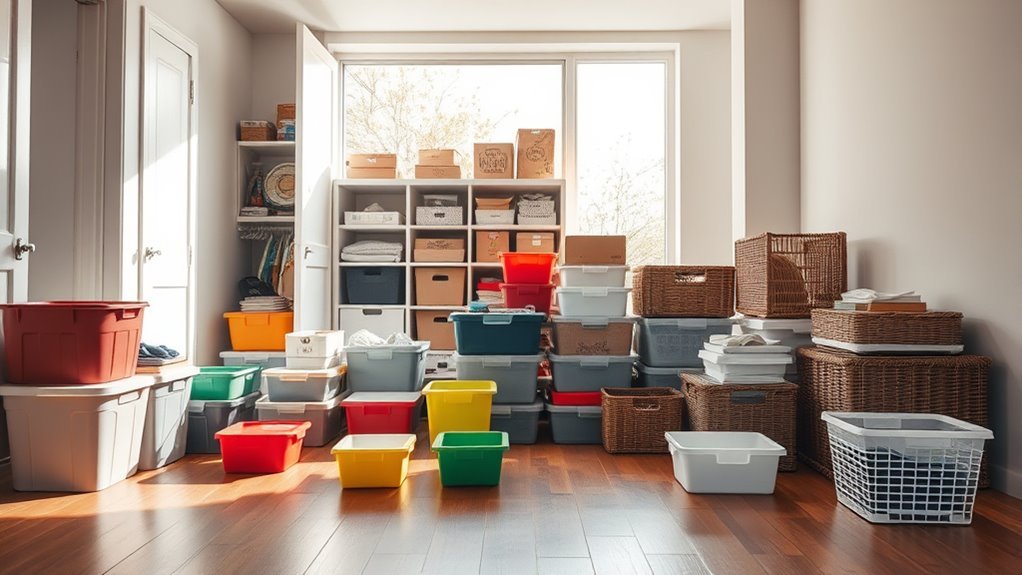
Before selecting a container size, you’ll need to accurately estimate your storage space requirements by measuring or listing the volume of all items to be stored. Start by creating a detailed inventory or using online calculators to determine the total cubic footage needed.
Pay close attention to large furniture and fragile items to ensure you allocate enough space. Efficient packing methods, like disassembling furniture and stacking boxes, can help you maximize storage space and possibly reduce the container size required.
Don’t hesitate to consult storage experts or use size guides to refine your space estimation. This careful approach guarantees you choose the right container size, avoiding unnecessary costs from overestimating or the hassle of running out of space later.
Comparing Storage Containers, Units, and Moving Trucks

While choosing the right storage option, you’ll find that portable containers, storage units, and moving trucks offer similar capacities but differ in convenience and purpose.
For instance, an 8-foot storage container provides about 320 cubic feet, matching a 10-foot moving truck or a small storage unit.
If you need more space, a 12-foot container offers roughly 576 cubic feet, comparable to a 15-foot moving truck or a 10×10 storage unit.
Larger options like 16-foot containers and 20-foot moving trucks provide around 768 cubic feet, similar to a 10×15 storage unit.
For extensive needs, 40-foot storage containers support up to 2,700 cubic feet, ideal for multiple households or businesses.
Understanding these comparisons helps you pick the best fit for your storage or moving needs.
Tools and Techniques for Accurate Space Measurement
Accurately measuring your space guarantees you select the right storage container size without surprises. Start with reliable measuring tools like a tape measure or laser distance meter to get precise length, width, and height of rooms and large furniture.
Use online room size calculators or smartphone AR apps such as Apple Measure or Google Measure for quick square footage estimates.
For bulky or oddly shaped items, take individual measurements to calculate volume estimation accurately.
Keep a detailed inventory listing dimensions and volume of each item to understand your total storage needs better. Remember to leave some extra space in your calculations for packing materials, stacking, and future additions, ensuring your chosen container fits everything comfortably and efficiently.
Tips for Efficient Packing and Space Optimization
When you pack your storage container efficiently, you make the most of every inch and protect your belongings. Focus on packing efficiency by disassembling furniture and stacking items to use vertical space fully. Use uniform-sized boxes and fill corners with smaller items for space optimization and stability.
Place heavy items at the bottom and fragile ones on top, leaving room for padding. Regularly check container dimensions and adjust your arrangement to maximize space.
| Packing Tip | Benefit | Example |
|---|---|---|
| Disassemble furniture | More vertical space | Stack bed frames flat |
| Uniform boxes | Easier stacking | Same-size boxes for books |
| Heavy bottom, light top | Prevents damage | Sofa cushions on top |
| Leave padding space | Protects fragile items | Bubble wrap around glassware |
Frequently Asked Questions
Should I Get a 10X10 or 10X15 Storage Unit?
If you’re packing up after college with just a few boxes, go for the 10×10.
But if you’re moving a two-bedroom apartment, you’ll want the 10×15 to fit your furniture and appliances comfortably.
Is It Cheaper to Build a Shed or Buy a Shipping Container?
It’s usually cheaper to buy a shipping container than build a shed because containers need less labor, no permits, and minimal maintenance.
Plus, containers are durable and portable, saving you time and long-term costs.
How Do I Determine What Size Storage Unit I Need?
You determine your storage unit size by measuring your items’ total volume, using online calculators, and factoring in packing efficiency.
Don’t forget to contemplate fragile or oddly shaped belongings, and ask experts for tailored advice.
What Are 27 Gallon Totes Used For?
You use 27-gallon totes to organize seasonal clothes, toys, or small household items. They’re perfect for moving or storage because they’re durable, stackable, and portable.
This makes them ideal for medium-sized items and inventory management.
Conclusion
Choosing the right storage container is like fitting the final piece in a puzzle—measure carefully, pack smartly, and think ahead to avoid space wastage.
Whether it’s a cozy 10-foot box or a spacious 40-foot giant, your belongings deserve a home that fits just right.
With thoughtful planning and efficient packing, you’ll open storage that feels less like a maze and more like a tailored sanctuary for your treasures.
In conclusion, selecting the perfect size storage container ensures your items are stored safely and efficiently, making your storage experience hassle-free and organized.