
How Long to Bake Salmon Simply for Perfect Results (Easy Guide)
When you’re baking salmon, timing is key to getting it just right—too little, and it’s undercooked; too long, and it dries out. Knowing how long to bake salmon is essential for a perfect meal. You might think it’s simple to toss it in the oven, but the right baking time depends on a few factors like thickness and oven temperature.
Getting these details right can transform your dinner. However, there’s more to take into account before you set the timer. Understanding these nuances will help you achieve delicious, flaky salmon every time.
Choosing the Right Type of Salmon

When choosing the right type of salmon, you’ll want to contemplate both flavor and texture.
Wild salmon, like sockeye salmon, offers a richer flavor and a deeper red color compared to farm-raised options.
Wild salmon, such as sockeye, boasts richer flavor and vibrant red hues over farm-raised varieties.
If you prefer a leaner fish, sockeye salmon is a great choice because it has lower fat content while still delivering bold taste.
Fresh salmon from the wild tends to have a firmer texture and more vibrant color than farmed varieties, making it ideal for baking.
Keep in mind that wild salmon generally has more complex flavors, while fresh salmon from a farm can be milder and softer.
Selecting the right salmon sets the foundation for a delicious baked dish, so consider your taste preferences carefully.
Preparing Salmon for Baking
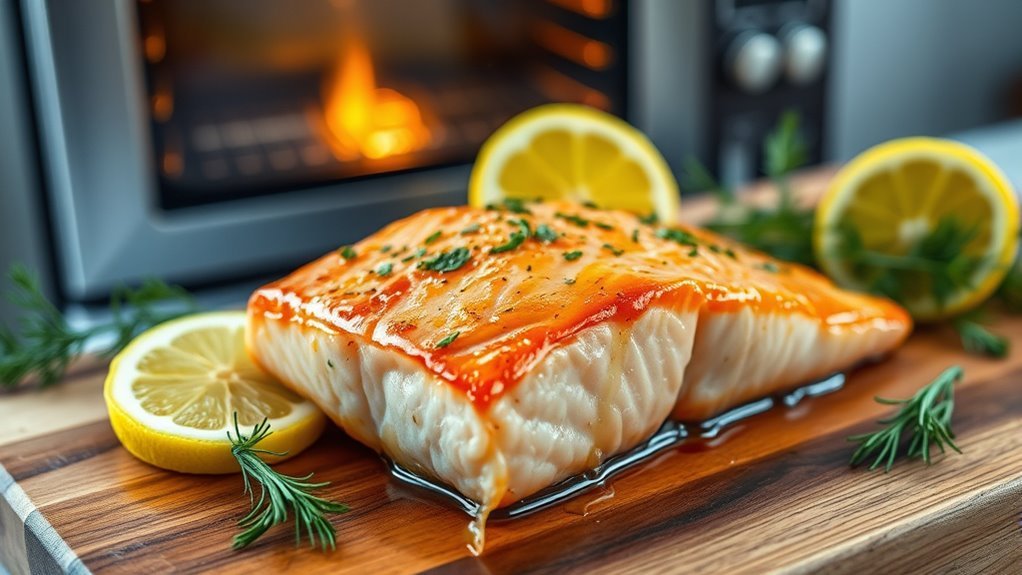
Before baking, let your salmon rest at room temperature for 15 to 20 minutes to guarantee it cooks evenly.
To prepare salmon properly, start by patting it dry with paper towels to remove excess moisture, which helps achieve a better sear and prevents steaming during baking.
Check carefully for any pin bones along the centerline of the fillet and remove them with fish tweezers or clean fingers.
If you’re using frozen salmon, make sure it’s fully thawed in the refrigerator or under cold running water before baking.
For skinless salmon, aim for even thickness throughout to ensure uniform cooking.
Taking these simple steps will help you prepare salmon perfectly for baking, resulting in a tender, flavorful dish every time.
Ideal Oven Temperatures for Baking Salmon

Although baking salmon requires careful temperature control, you’ll find that setting your oven between 375°F and 400°F strikes the perfect balance for even cooking and moisture retention.
At 400°F, the baking time for a 1-inch thick fillet is usually 12 to 15 minutes, yielding a flaky, tender texture.
If you prefer a gentler cook, 375°F requires about 15 to 20 minutes, helping prevent overcooking and ensuring even doneness.
Avoid oven temperatures above 425°F, as they can dry out or burn the edges before the salmon is cooked through.
To nail the perfect bake, use an instant-read thermometer and aim for an internal temperature between 135°F and 145°F.
This guarantees your salmon is juicy and safe to eat.
Calculating Baking Time Based on Thickness
Setting the right oven temperature is just the start; knowing how long to bake your salmon depends largely on its thickness.
As a general guide, bake salmon for about 4-5 minutes per ½ inch of thickness at 375°F.
For example, a ½-inch fillet needs around 10 minutes, while thicker cuts may require 15-20 minutes of baking time.
To ensure perfect doneness, use a food thermometer. Salmon is done when it reaches an internal temperature between 135°F and 145°F.
Use a food thermometer to bake salmon perfectly at 135°F to 145°F internal temperature.
Keep in mind, wild salmon cooks faster than farm-raised due to its leaner flesh, so adjust baking time accordingly.
Start checking a few minutes early to avoid overcooking and enjoy perfectly baked salmon every time.
Signs Your Salmon Is Perfectly Baked
When you bake salmon, knowing the signs of perfect doneness helps you avoid overcooking. First, check for doneness by observing the flesh; perfectly baked salmon is opaque and flakes easily with a fork.
The thickest part should feel firm yet moist, with no translucent raw spots. Press gently; if the fish springs back, it’s finished cooking. The edges might show a slight golden hue, indicating it’s done without being dried out.
For accuracy, you can use a thermometer and ensure the internal temperature reaches between 135°F to 145°F, based on how well-done you like it. Trust these signs, and you’ll serve salmon that’s tender, juicy, and perfectly baked every time without second-guessing.
Broiling Tips for a Crispy Finish
If you want a crispy finish on your salmon, broiling it for 2 to 3 minutes at high heat works wonders. Position the oven rack about 6 inches from the broiler element to get even crispiness without burning.
Pat the salmon dry before broiling to enhance browning. Keep a close eye on it, as it can quickly go from golden to charred.
If it’s cooked through but not crispy enough, broil for an extra 1-2 minutes, checking frequently.
| Tip | Why It Matters |
|---|---|
| Broil 2-3 minutes | Crispy top without overcooking |
| Oven rack 6 inches | Even crisping, no burning |
| Pat dry | Better browning and crispiness |
| Watch closely | Prevents charring |
| Extra 1-2 minutes | Adds crispiness if needed |
Storing and Reheating Baked Salmon
Although baked salmon tastes best fresh, you can keep leftovers flavorful by storing them properly in an airtight container in the refrigerator for up to two days. This helps preserve moisture and prevents the fish from drying out.
When you’re ready to reheat, do it gently to maintain its texture. The best method is warming it in the oven at 275°F for 10-15 minutes, which evenly restores heat without losing moisture.
If you’re short on time, use the microwave on medium power in 30-second intervals, checking to avoid overheating. Avoid over-reheating, as it can make the salmon dry and tough.
You can also freeze baked salmon for up to two months; just thaw it overnight in the fridge before reheating in the same gentle way.
Frequently Asked Questions
Is It Better to Bake Salmon at 350 or 400?
It’s better to bake salmon at 350°F if you want a tender, moist fillet with even cooking.
But if you prefer a slightly crispy top and quicker cook time, go for 400°F. Just watch it closely.
How Much Time Does It Take to Bake Salmon?
You’ll bake salmon for about 12-15 minutes at 400°F, depending on thickness. Thinner pieces need less time, thicker ones a bit more.
Check at 12 minutes to avoid overcooking and dryness.
How Long to Heat up Salmon at 400 Degrees?
You’ll heat salmon at 400°F for about 8-10 minutes if it’s a small portion, or 12-15 minutes for larger fillets. Keep it covered with foil and check for an internal temperature of 125-130°F.
How Long to Cook Whole Salmon in the Oven at 350 Degrees?
Don’t beat around the bush. Bake your whole salmon at 350°F for about 20-25 minutes, or 15 minutes per pound.
Make sure it flakes easily or hits 145°F inside for perfect doneness every time.
Conclusion
Now that you know how to bake salmon perfectly, you’re armed like a knight with the right tools and timing. Remember, checking early and aiming for that tender, flaky texture keeps your fish moist and flavorful.
Whether you’re using a classic oven or a futuristic broiler, trust your instincts—and your thermometer. With a little care, your salmon will always come out just right, proving some culinary arts never go out of style.
When it comes to how long to bake salmon simply, timing is key. Follow these guidelines for perfectly cooked salmon every time.